Over the Waves: M/V Avalon Voyager II
It’s been a while, but I am so excited to get back to writing and creating maritime-related content. While going through my notes and trying to decide what to write about next, I found some pages on Fathom Five National Marine Park in Tobermory, Ontario. High on my list of places to visit, Fathom Five is a popular tourist destination off the tip of the Bruce Peninsula, right on the channel between Lake Huron and Georgian Bay. Seventeen wrecks are scattered throughout the park, offering plenty of opportunities for divers and boat tours alike. I made up a list of the vessel names, picked one at random, and started my research.
Of course, I managed to pick the only vessel with a Newfoundland origin story.
So, welcome back to the Original Shipster. Today, we’re diving (pun intended) into the history of the M/V Avalon Voyager II.
Ship Stats
Nationality: Canadian
Length: 41.2m (135 ft)
Beam: 8.5m (28 ft)
Depth: 3.6m (11.8 ft)
Gross Tonnage: 325.33
Year: 1946
Wrecked: Cape Hurd, Georgian Bay, ON, October 31, 1981
Other names: Twillingate, Thomas V. Hollett, Avalon Voyager
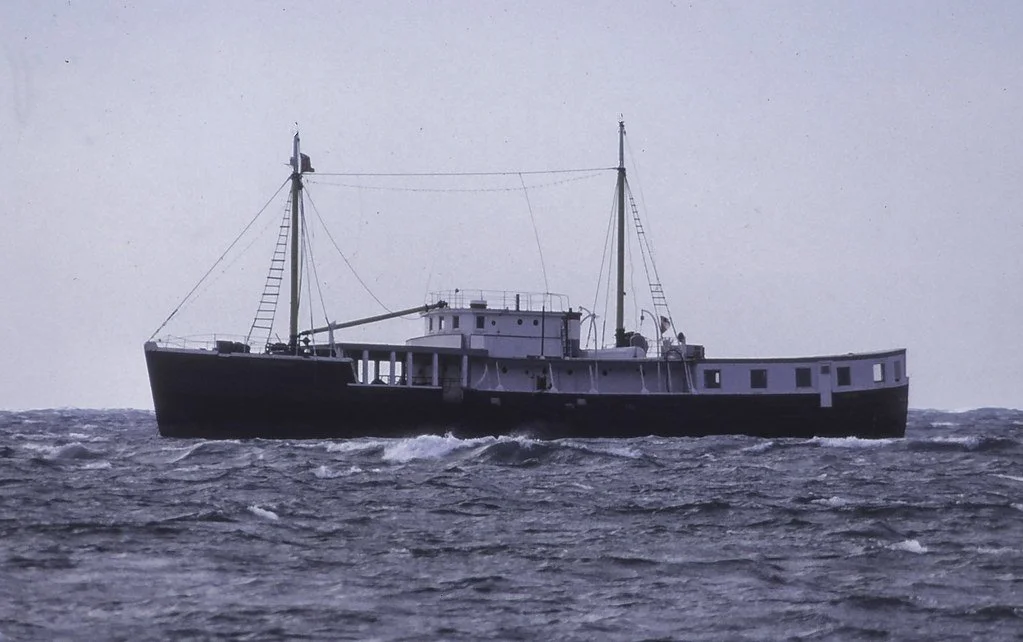
M/V Avalon Voyager II. Photo Credit: Jack Salen, Flickr.
Background
For much of Newfoundland and Labrador’s history, coastal boats like the SS Kyle and the SS Clyde were the primary method of travel. In addition to moving people around the province, these ships would travel beyond our shores, moving passengers and cargo alike to New York, Quebec City, Liverpool, and beyond. During the First World War (1914-1918), some, including the SS Florizel, were commissioned to transport troops from Newfoundland to the United Kingdom.
Over the course of the Second World War (1939-1945), Newfoundland suffered a shortage of coastal vessels. The Commission of Government created the Clarenville Shipyard in 1942 with the purpose of building ten new, wooden vessels to help supplement the fleet. These ships would be made of local materials, when possible, with other materials brought in from across Canada. Placing the shipyard in Clarenville was a strategic decision, not only because of its proximity to the railway line, but because many in the area had wooden boatbuilding experience.
Construction of the “Splinter Fleet” – named for their wooden build in a time when most ships were steel – began in 1943. The first ship, the M/V Clarenville, was launched on July 12, 1944, with the Trepassey, Glenwood, Placentia, Ferryland, Codroy, Burin, Bonne Bay, Exploits, and Twillingate following over the next couple of years. The Clarenville was immediately commissioned to carry freight and passengers along the northwest coast of Newfoundland. The M/V Trepassey sailed to London and was used by the Royal Navy as a supply vessel for their bases in Antarctica. Some ships travelled to the Caribbean with cod fish, returning with rum, molasses, coal, and salt, while others supported costal routes around Newfoundland and north to Labrador.
The M/V Twillingate launched on January 29, 1946, with an oak keel, white pine decks, and structures made of yellow birch, spruce, and British Colombia fir. Initially, it was intended to be a coastal minesweeper, but with construction completed so close to the end of the war, it was put into service as a general cargo vessel. Following the war, Newfoundland struggled to reconcile its finances, and in 1949, the Twillingate and the rest of the “Splinter Fleet” were sold by the government as part of a liquidation of assets prior to Confederation with Canada. The Twillingate was purchased by Hollett & Sons of Burin, Newfoundland, and set sail for its new home.
Upon her arrival, the ship was renamed the Thomas V. Hollett after Captain Thomas Vigus Hollett, a prominent local merchant and the founder of the company who had passed away in 1947. After a refit, the Thomas V. Hollett transformed from cargo vessel to fishing trawler and for the next decade it fished off the Burin Peninsula. However, a lack maintenance resulted in the vessels withdrawal of its classification and eventual removal from the Lloyd’s Register of Shipping in August 1963. Shortly thereafter, the owners began searching for a new buyer.
In the late 1960s/early 1970s (sources are conflicted on this), the Thomas V. Hollett was sold to Art Scott of Toronto, ON. Upon its arrival on Lake Ontario, it was fitted as a barracks for the crew of Scott’s towing enterprise. Over the next few years, it fell into neglect and disrepair, gradually wasting away on the shores of the Great Lakes.
In the mid-1970s, the ship returned to service. After moving from Toronto to Kincardine, ON, the ship was renamed Avalon Voyager II and renovated from workhorse to floating seafood restaurant. Attracting tourists and locals alike, the restaurant did well for the first couple of years, but the owners decided they wanted to expand their business. They opted to relocate the Avalon Voyager II to Owen Sound, a larger hub on the other side of the Northern Bruce Peninsula. The hope was that the relocation would increase business for the venture, given the amount of tourists who move through this area during the summer.
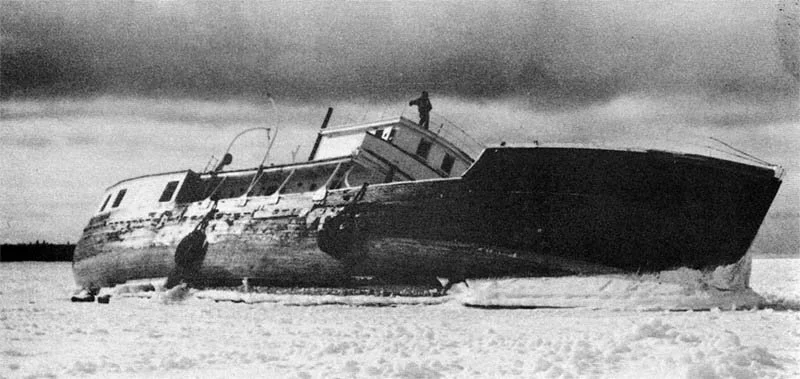
The M/V Avalon Voyager II wrecked off Bonnett Island, Bruce County, ON.
The Wreck
On the morning of October 31st, 1980, the Avalon Voyager II set out from Kincardine. The weather was clear and calm as the crew settled in for what started out as an easy, routine journey. The area around Lake Huron/Georgian Bay, known for its unpredictable autumn weather, had other plans, and conditions deteriorated rapidly until the ship was fighting gale-force winds and high waves. This was no longer a routine crossing.
At the entrance to the Cape Hurd channel, about halfway between Kincardine and Owen Sound, the ship’s water pump belt broke and the engine began to overheat. The crew dropped the anchor and sent out a mayday. The fishing tug W.A. Spears out of nearby Tobermory responded to the call, managing to safely rescue the crew from the now heavily rolling Voyager. The crew watched as the force of the waves began to drag the anchor along the bottom and push the ship towards the shore. Eventually, the Avalon Voyager II struck a rock on Bonnet Island near Cape Hurd, becoming firmly wedged against the shore.
The W.A. Spears got the crew to shore, where they waited out the storm. Once the weather calmed, they returned to the ship to assess the damage. Despite a heavy list to port, they were surprised to find the Avalon Voyager II mostly intact. All the furnishing and equipment were removed, and the ship was prepped for salvage. However, Bonnet Island was not going to give this ship up, and despite their best efforts, the Avalon Voyager II was eventually abandoned.
For the next two years, the ship rested on the coast of the island, beaten and battered by the waves of the channel during most of the year, and trapped in ice during the winter. In February 1982, a group took advantage of the ice bridge between the ship and shore and set the ship ablaze. The fire tore through the interior and gutted the hull, with the charred remains slipping below the surface.
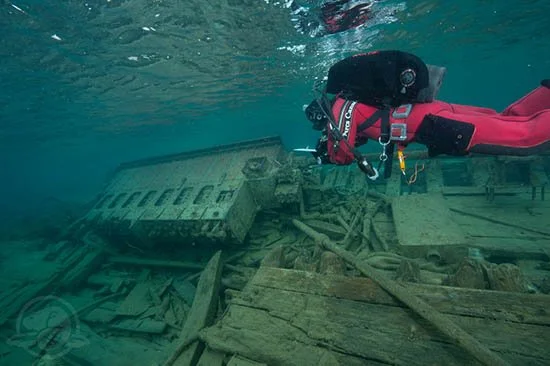
Diving the Avalon Voyager II. Photo Credit: Parks Canada
Conclusion
Today, the M/V Avalon Voyager II sits in 25 feet of water off Bonnet Island, part of the Five Fathoms Marine Park. The wreck is a popular diving site for visitors to the park due to its accessibility and the vessel’s interesting history.
These are my favourite kinds of stories to write about. It’s fascinating to me that a vessel built in Clarenville, Newfoundland could be a cargo ship, fishing vessel, crew barracks, and floating restaurant before finding its final resting place, 3200km and 40 years later, in Georgian Bay.